Cello Care and Maintenance
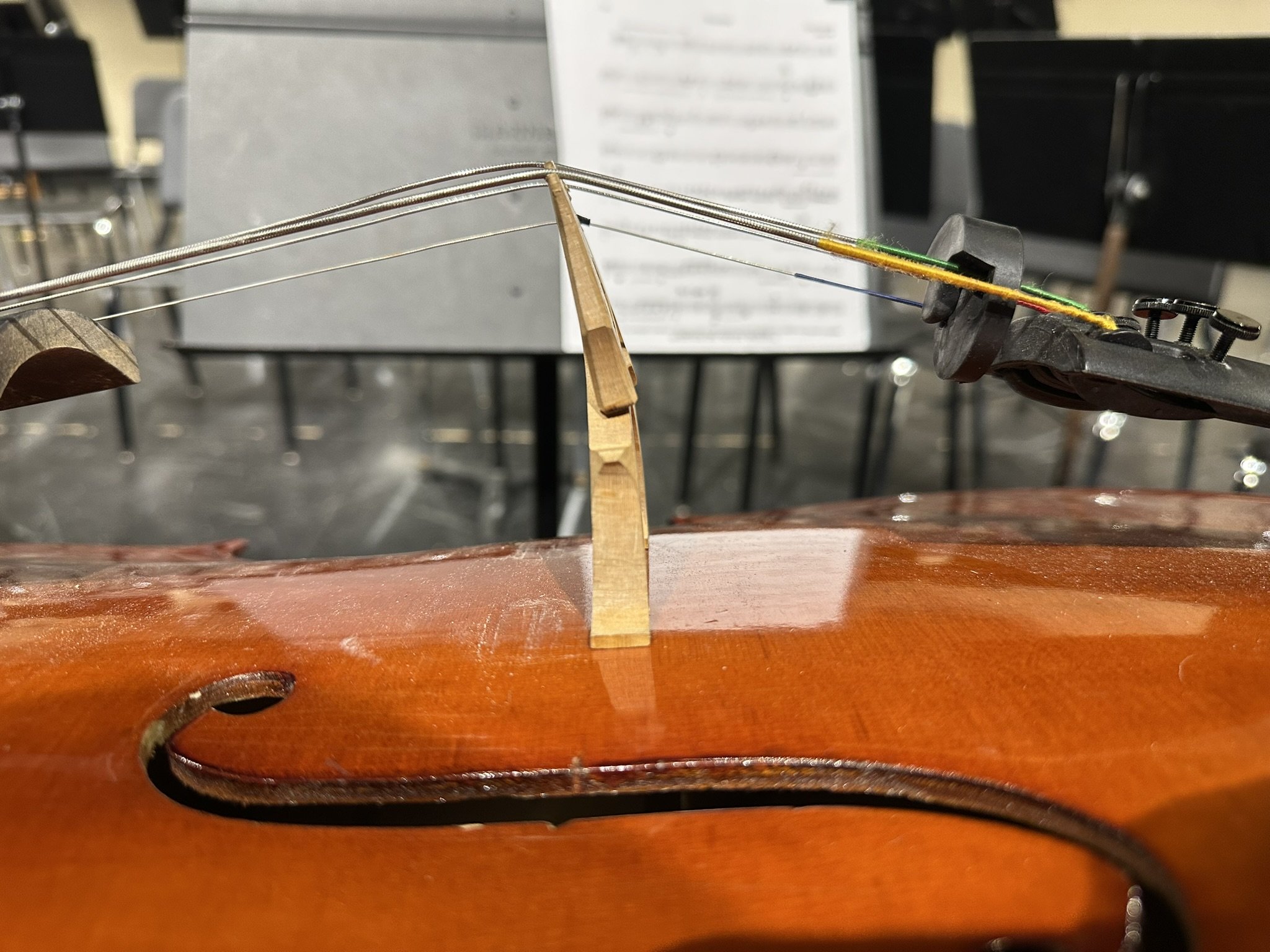
Warped cello bridge
The Basics
An easy general rule to follow is: If you are uncomfortable, your cello is. You would not like to be too hot or cold, humid or dry. Cellos like to be at room temperature with a neutral humidity (40-60%). This can be a challenge during winter specifically.
Wipe your cello regularly.
Any dry cleaning cloth is good. Microfiber is nicer than cotton. Use one part of your rag/cleaning cloth for the strings, and a non-rosined part for the body of the cello. Some people like to use steel wool or similar products for more thoroughly wiping the strings, but it is not necessary. Dust off any rosin especially during hot and humid days or it might melt and stick to your instrument. I have also been told that using alcohol wipes on the fingerboard is a thing people do to remove rosin gunk. While I have tried it and it works, there is significant risk to your varnish if you drop any of the alcohol on it. Just leave the rosin or try and get it off with a cloth. I do not use polishes for fear of damaging the varnish. Avoid touching your varnish too much as well. Wash your hands before touching your cello.
Keep your instrument in a safe place when not in use.
When you put your cello down, keep it on its side. The body is rounded so it will rock, also it’s easier to break it. Put the endpin in if you are going to leave it for a while. If you leave your cello out during rehearsal breaks, expect people to try and walk over your instrument (please do not). I always return my instrument to its case during these breaks.
Cello stands are fine at home, but expect some dust accumulation. Our luthier also mentioned that instruments “like to be tucked in,” meaning that the sealed environment of the case is beneficial. A case is necessary when near young children or pets.
Loosen bow hair when packing up. It does not need to be super loose, just relieve the bow of tension. Avoid touching the hair of the bow – the oil of your skin will accumulate on the hair.
Do not leave your cello in direct sunlight. Try to avoid being under trees too. Pollen and sap can fall on your instrument.
Do not leave your cello in the car. I bring it inside when I know it will take a while (restaurants, visiting people, etc.). You would not leave a puppy or baby in the car.
Tuning Using the Pegs
Sometimes your strings fall drastically out of tune, or you cannot further fine-tune a string. You will need to learn how to use the pegs. If you are not comfortable tuning with the pegs, have someone do it for you.
First, if your strings all went loose and the bridge fell over, be sure to look inside to see if the soundpost is still up. Do not put full string pressure on the bridge if the soundpost has fallen. Take your instrument to a luthier as soon as you are able.
If the soundpost is okay, make sure that the back of your bridge is straight up and down. As you tighten the strings, the top of the bridge will be pulled towards the pegbox. Try to push the face of the bridge when you still have lower tension to keep the bridge straight. Failure to do so is what commonly causes the warping of the bridge over time (see picture at top).
If all the strings have become loose, tighten them evenly while tuning back up.
Always loosen the peg before tightening. Having broken at least one or two A strings, most of the time it was because the string was already somewhat tight. We generally want to tune up into the higher pitch.
As you tighten the string, make sure to put inward pressure toward the pegbox so that there is sufficient friction between the peg and the holes to keep the peg from slipping. If the peg seems stuck or you cannot apply enough pressure to keep the peg from slipping, it is likely you might need to add a small amount of peg compound.
Take your time when first learning how to use the pegs.
Winter Care
The cold and dry air is terrible for instruments.
Humidifiers
Heat dries out the wood of your instrument and will make it contract. Keep some humidifiers in your case and try to maintain 40-60% humidity where you store your instrument. Very difficult to do, but try your best.
Boveda Humidifier Packs 49% RH - ($26 Starter Kit, $4-5/each for additional pouches)
Shar: Boveda Large Instrument Starter Kit
Amazon: Boveda Large Instrument Starter Kit
These were recommended by our luthier, also recommending that we avoid using the Dampit style humidifiers. He also said they can be “recharged”. Set and forget two-way humidifying packs to keep your instrument happier during Winter. The covering pouches are made of soft material that should not scratch your cello.
Dampit and Humidi-Guard ($15 - $20)
While not the recommended method of keeping your cello from drying out, I will still talk about these a little. Basically a small sponge in surgical tubing. If you choose to go this route, definitely squeeze some water out from the sponge and completely dry the surface of the humidifier before putting it inside your cello. These dry out within a day or two, so you will need to regularly water them.
Room humidifiers can be used in conjunction with your case/instrument humidifier. The smaller the room, the more effective. Our local luthier has a couple giant humidifiers to keep their shop the appropriate humidity for wood. They also run dehumidifiers during summer.
Temperature
Keep your instrument in a well regulated room. Try and let your cello warm up gradually if you just had it out in the cold. Keeping it in the case a little longer before unpacking will help with that.
Checking for open seams
This is a totally normal and natural occurrence. It is a fast, inexpensive, and easy repair for your luthier.
If your cello sounds weird or buzzes, you should check for an open seam. They are typically hard to see, so knock on the cello lightly with your knuckles near the perfling. Go all the way around the front and back of the instrument. Open seams sound like two pieces of wood smacking together when they are knocked. Comparatively, it should sound like one solid piece. Luthiers will also pull on the edge to try and see if it opens more. You do not need to do that.