Cello Case Shopping Guide
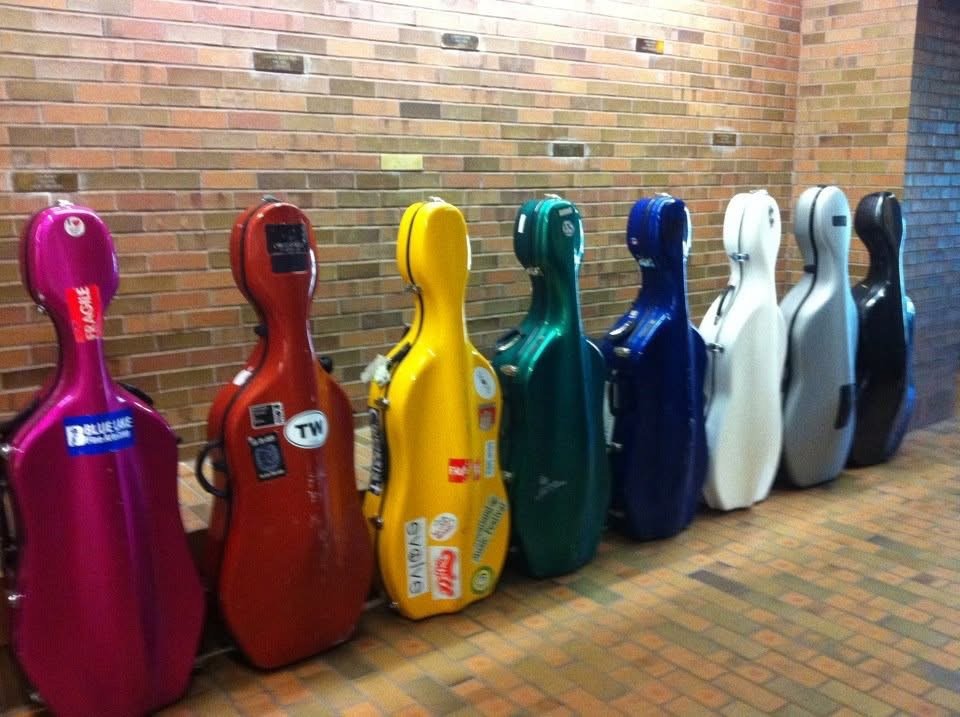
Cello case rainbow at WMU
This article is for those that are looking to buy a hard case for their instrument. Whether you are shopping for your first or replacing your years-old case, I will walk through some considerations I had when recently shopping myself.
Last Updated: February 2026
Budget
Probably the most important aspect to consider. Hard cello cases have gotten cheaper and better in recent years, though the usual adage of “buy nice, or buy twice” can still apply. Any case you purchase should last at least 7-8 years minimum. Try to purchase during sales as prices have skyrocketed recently.
Generally:
Any case under $1000 gets you basically anything you need. (Eastman, lower end BAM, Bobelock, etc.)
$1000 - $2000 gets nicer features: lighter cases, better thought out designs. Diminishing returns after about $1500 (Bam Newtech, Gewa Air, Musilia etc.)
$2000+ this is where diminishing returns really hits, mostly get higher end materials, luxury design, super-light cases. (Higher end BAM, Musilia, Acase/Accord, Stevenson, etc.)
Fit
Your cello has to fit in the case properly. Visit local shops to try out the different models they have to see if your instrument can fit in the case. If your friend or colleagues own a case you are interested in, ask them if you can try it out (and what they like/dislike). Contact shops if you cannot visit in person. They should be happy to help you out. Take any measurements with a cloth tape measure.
Ultra sleek/slim cases will have more fitting issues. For example: My instrument did not fit in BAM Slimtech when I was checking around. The scroll was contacting the back of the case.
Features
I will separate this into two parts, outside and inside the case features.
Features Outside the Case
Weight and Wheels - How heavy is it?
Lately my thoughts on this are, “I do not really care.” Personal strength or back health can play into your decision here though. Most hard cases these days average about 9-12 lbs. The lighter carbon fiber models tend to be around 7 - 10 lbs. The straps and your personal carrying method make a bigger difference to comfort. I tend to only carry my instrument with one shoulder strap rather than wearing it as a backpack, so that makes it “feel” heavier. Wheels can be nice on occasion, but really only work on absolutely flat surfaces due to their small size. I did use them to roll my case into the trunk. You may as well not have them and save some weight. Great caution should be used when deciding to roll your cello on a given surface, since the vibrations can gradually knock your bridge or sound post out of alignment.
Materials
Speaking of weight, the material of the case is what makes most of the difference. I have had both standard and extra lightweight cases. Furthermore, the plastic material of many models is far better for insulation against large temperature changes. If you live in a place with seasons, I would recommend avoiding carbon fiber/lightweight cases. Most materials are good enough to protect from bumps and scratches during your normal walking around and car loading. I will not talk about flight cases in this article - those are designed for checking your cello in. Most people will buy a second seat for their instrument.
Latches
This is one of the most important parts of the case, and the most likely to fail. Simpler latches last longer in my experience. The old-school flapping latchs with no springs are the most reliable. Spring loaded levers seem to last well enough, but I have heard that they do break. BAM’s old latch design is more complex and for sure will break eventually (last years though). I do not have experience with the updated design.
Fewer latches is generally nicer so you will not need to open/close as many. Most cases have latches on all sides but a few have different placement that allow it to be latched without bending over as much. A few cases feature a single lever to open the case, it sounds cool but if that breaks you are in trouble.
Locks on latches might seem like an essential and useful security feature, though I have never once locked my instrument case. All it would do is slow down my cello unpacking process. The addition of a combination lock on the case is the same, I will probably never use it and won’t bother even setting a combo. You will likely be the only person who touches your case, just avoid leaving your case unattended in public places.
Handles
Generally, any handle they put on a case is fine. Cases will commonly only have one handle on the shoulder opposite the main carrying handle. Keep an eye on your handles as they can and will break eventually. I had a main handle break while I was loading my cello into the car, it caused some significant damage when the case swung and hit the ground.
Strap and Strap Systems
These have improved a lot, they have gotten wider and grippier. Attachment methods have changed to mostly be carabiners with safety wire. If your case does not have the safety wire, consider adding it. The disadvantage is that carabiners do not freely spin.
Some companies will sell compatible backpack style systems, while I have not used one (mostly due to my carrying style), I am sure they are comfortable. They are a bit pricey, averaging around $200-400.
Case Balance
On an ordinary day your cello case will stand vertically. Most cases are perfectly and confidently stable while upright, but when you get into some light weight cases or more interesting designs, this stability can be compromised. Just be aware and set your case on its side if you are uncomfortable.
Style and Color
Up to personal preference here. I went with a white case this time around since I wanted to be more visible in the evenings when we are often rehearsing. Also, to prevent my instrument from cooking during the summers. I will say, I do not like the BAM Shamrock shape aesthetically.
Replacability / Repairability
Most, if not all, companies use rivets to secure the latches in place. These are a giant pain to work with. Even if you can buy replacement parts, just have someone else do it for you. I have replaced four latches on my old BAM case and it took two people and a few hours, with some rivets breaking. This applies to handles on the case too.
Features Inside the Case
How are the cello and bow held? Do you have room for your essential accessories?
Padding and Suspension
Your cello should fit snugly in your case and be barely able to move. Many cases now have adjustable padding that you can move around. Cellos are often suspended from the bottom of the case in some fashion or another, which should help prevent damage if your case is dropped for whatever reason. One previous case used adjustable padded blades, this turned out to be a very bad idea as it caused the damage from the handle breaking. I will mention my cases later in this article.
Neck Strap
The most common styles of cello retention are velcro and plastic clips on nylon straps. Old school cases might use a belt buckle style and recently, some have a ratcheting strap. Avoid velcro, it wears out and will not keep your cello safe when it does. Plastic clips are common, great, and reliable. The new ratcheting system is reliable.
Scroll Retention
This is not necessary if your cello fits properly into the foam padding of your case. Commonly you will have either an elastic loop or an adjustable nylon loop. Either will serve you well if present.
Bow Retention
The most common style of retention is velcro, I will repeat - velcro is terrible with time. Other bow retention styles are: buttons, zippered pouches, and magnets. Buttons are old-school, but seem reliable. Zippered pouches are a newer development and I like the idea. Sometimes bow hairs will rub against the front of the instrument and this completely prevents that at the cost of taking a little more time to use. Just be careful not to catch bow hairs in the zipper. As for the magnet, I am a huge fan of this one. Quick and easy to use.
Accessory Pouch
This is the little pouch you can keep your spare strings and rockstop at minimum inside. Make sure your instrument fits with this pouch filled. You will commonly find the accessory pouch at the scroll or one of the C bout positions. Having used both, I prefer the scroll position. The pouch would sometimes block my instrument from fitting in easily. Some accessory pouches are detachable. A cool feature at first, but then you realize how floppy it makes the pouch - avoid.
Consider how the pouch is closed as well, velcro (terrible), button, magnet. I wish my case had a magnetic closure.
Where to Buy a case
See our Useful Links page or Useful Links Expanded article.
Short list:
Shar Music
Johnson Strings
Linda West Cellos
Any reputable violin shop. Try and get free shipping. Around Black Friday is a good time to shop.
Personal Experiences
That is a lot of information already. Now I will write about my experience with cases so far from oldest to newest.
BAM - Newtech with wheels
Price: $600? This case came with the cello I got in middle school. It also has a deformity.
Current MSRP $1,600+ (woof)
Used from 2004-2013, again for a few months in 2025.
Very reliable and stable case, at the time was the gold standard. The case protects well from both impact and temperature changes. One carrying strap failed at the clip and most latches have broken. I did replace most of the broken latches, but it was very inconvenient setting new rivets. The latches lasted for about 5 or 6 years before failing, but when too many broke I was using a belt and a luggage strap to try and keep the case closed. That was a fun couple of years…. While in storage, the foam or whatever they used in the accessory pouch deteriorated and has been leaving that mess on the things I put in there. The pouch has also developed a hole. The shoulder handle has gotten a bit loose over the years and will probably break with continued use.
Did okay over the years except the latches and one strap, still functioning as a good backup case for me.
Musilia - S2
Price: $1500ish with some sale, $1600 msrp at the time.
Currently $2,200 MSRP (woof!)
Used from 2013-2025
This case is very sleek and lightweight, being made of carbon fiber. The strap system is interesting. Being a single long piece of nylon threaded through eyelets on the case, it is indestructible, but not that adjustable. The nylon had a couple sliding cushioned sections, but those would slip around making this a little annoying to carry around especially with a winter coat. I put the unbroken BAM strap on as well and used that in winter for its grippiness. Inside the case is a removable accessory pouch which I mentioned earlier was cool at first, but it wiggled around and made it annoying to put the cello inside sometimes.
This is where we go from inconvenient to actually bad.
The velcro neck retention was almost useless from the beginning, and the plastic or pleather it was attached to nearly broke off before I replaced it with a clip (more riveting nightmares). Their new cases have the clip. I would sometimes find the bows had escaped their velcro too. The one I used most often has very worn velcro and is almost useless.
Carbon fiber is terrible material for keeping your cello insulated from temperature changes. During winters, my cello went out of tune often. Even with an over-the-case padded hoodie style bag. Thankfully I did not have to have my soundpost re-seated. Once, the cello was tipped over and I had to have major neck repairs done (make sure you have instrument insurance!). The handle, which was made of that neck strap pleather, broke while I was loading my instrument into my car, leading to damage on the lower bout. The padded blade suspension that I mentioned above was the likely culprit of this damage. Another major repair covered by insurance. I am sure they hate me now since they’re charging more. Musilia have since changed the handle to some sort of similar material covering a foam grip. I am not sure about this one’s durability. I tried to replace it, but am not proficient with the rivet gun so it remains broken. Temporarily fixed it using some twist tie wire. The shoulder handle was a small additional purchase, but its quality and durability leaves much to be desired.
Overall slightly annoying to terrible experiences with the superlight carbon fiber case. I did like this case at first, then all the problems presented themselves as time went on.
Gewa - Air 4.9 (Current Case)
Price: $1200ish sale price
About $1500 MSRP
Used from Nov 2025 - Present
My current case has been a pleasant experience so far. Being made of thermoplastic, it has resisted this year’s cold weather admirably so far. I used to use a silk cello bag in addition to the case and do not feel the need with this case. This one has fewer latches and they are all on one side. The straps are nice and wide, though maybe a little short for my taste. They are held by carabiners with safety wire. Inside the case is nice, the cello is suspended above the bottom of the case with an adjustable hammock system. The bottom of the cello is completely suspended from the bottom of the case. That open space is a good place to put Boveda humidity packs. There is adjustable foam near the neck. This is the most snugly my cello has fit into a case. The neck is held by a plastic ratcheting clip - so far, so good. It does take a little more coordination than clips, but both are two hand systems anyway. Bows are held by magnets, this is probably my favorite bow retention so far, they will not fall out at all and not wear out over time. The accessory pouch is solidly fixed near the scroll and stiffer than most however, I do like it for that. I only keep a couple things in there anyway.
One downside is that the case is less balanced than the others I used. It is fine on flat hard surfaces, but on carpet it can be unstable. This might be because the cello sits slightly higher in the case and other factors like softer feet and different clamshell ratio. The back shell does have some supports for laying it down, but I never open my case while it is laying flat.
A couple months into daily usage and the case is doing great so far. A fantastic balance of price and performance. You will run into quite a few cellists with this case these days.
If you have read all of this, thank you for your time, and I hope you are better informed about what to look for in a hard cello case. Please share this if it has been useful and feel free to give feedback and your own experiences with cases. Expect detailed reviews of each of my cases eventually.